

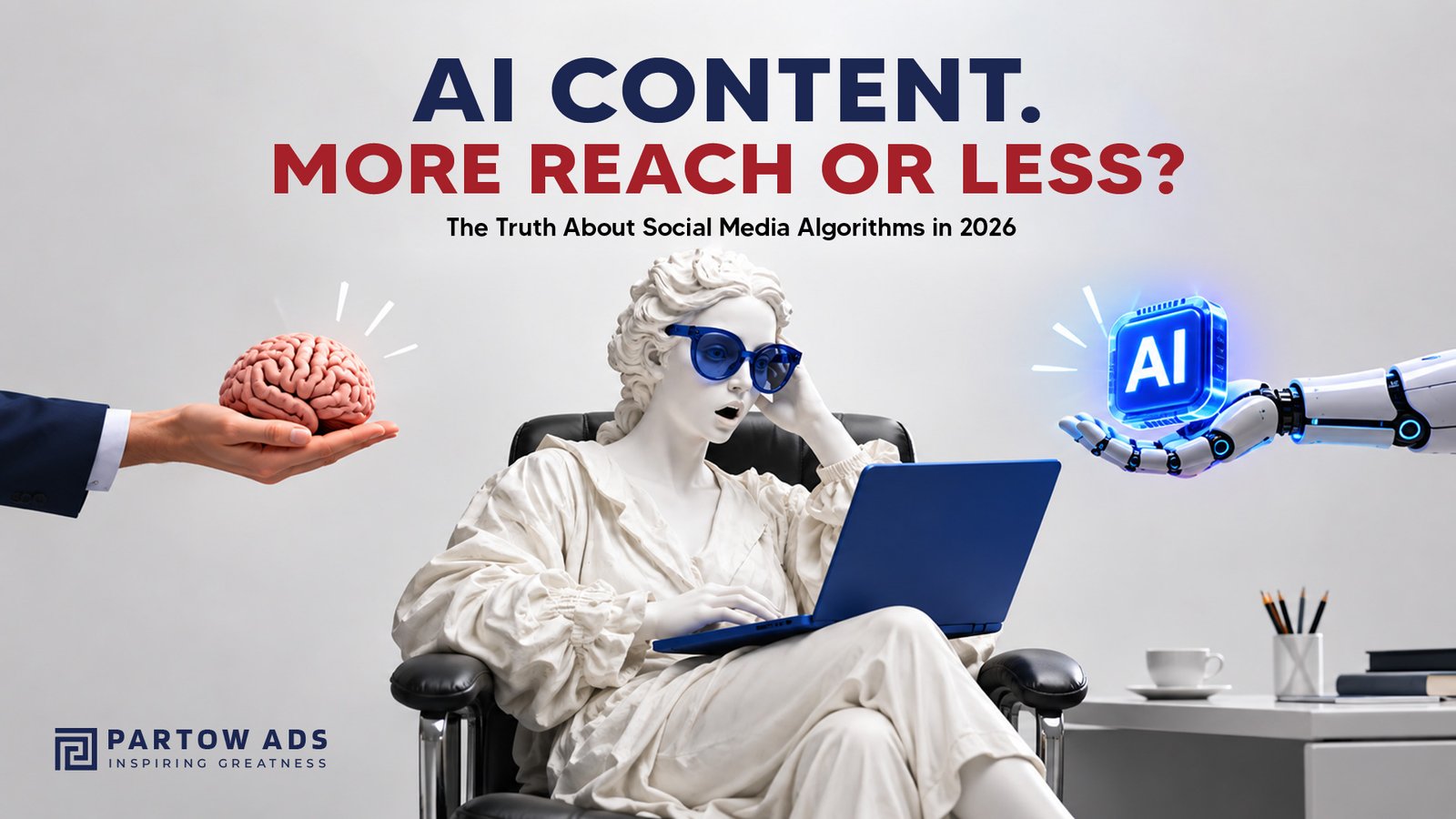
The 2026 reality of AI-generated content on TikTok, Instagram, Facebook and YouTube
AI Is Everywhere. But Is It Hurting Your Reach?
You have probably seen the claim: “Social platforms are killing AI content.” It sounds simple. The actual platform policies are not.
Across the primary guidance reviewed for this article, there is no blanket rule saying that a post or video automatically gets less reach simply because AI was used to make it. What the platforms are increasingly explicit about is something else: originality, viewer value, repetitive or mass-produced content, spam, and transparency around realistic synthetic media. Meta, YouTube and TikTok all describe versions of that problem in their current guidance. [1][2][3][4][5]
That distinction matters for brands. AI can help a team research faster, generate concepts, clean up edits, produce variations and test creative directions. But when the tool becomes a shortcut to publishing dozens of generic posts that look and sound interchangeable, the content can become less useful to people – and that is where both platform policy and audience behavior start to matter.
| The answer in one sentence AI itself is not the documented enemy; low-value sameness is. The strongest 2026 workflow is human-led strategy and original material, accelerated by AI where it genuinely adds speed or creative range. |
What the platforms actually say in 2026
It is useful to separate platform policy from internet folklore. Here is what the primary sources currently show.
Facebook: Meta is explicitly rewarding originality
In March 2026, Meta said Facebook was prioritizing original creators with greater reach and monetization while reducing the distribution of unoriginal content. Meta also reported that views and time spent watching original Reels on Facebook approximately doubled in the second half of 2025 compared with the same period in 2024. [1]
Its guidelines describe unoriginal content as, among other things, duplicative uploads or posts that make only low-value changes to someone else’s work. Examples include re-uploading another creator’s content or adding superficial changes such as borders, captions or speed changes. [1]
Notice what is missing: an automatic “AI penalty.” The concern is whether the content is original and meaningfully valuable, not whether the creator used an AI tool somewhere in the workflow.
Instagram: originality is increasingly part of recommendations
Meta’s January 2026 update says Instagram increased the prevalence of original content in the United States by 10 percentage points in Q4 2025, with 75% of recommendations in that market coming from original posts. [2]
That is important context when a brand asks, “Will Instagram punish my AI post?” The more useful question is whether the post gives Instagram something original and worth recommending. A fully human-made post can still be weak. A hybrid post that uses AI for production but contains original photography, a distinctive concept, useful information or a real person can still offer genuine value.
YouTube: the risk is mass-produced, repetitive content
YouTube’s Partner Program guidance was updated in July 2025 to clarify its existing position on repetitive, mass-produced material, now described under “inauthentic content.” YouTube says monetized content should be original and authentic, and should not be mass-produced, generic or repetitive. [3]
AI disclosure is a separate issue. When creators disclose realistic altered or synthetic content, YouTube says the disclosure itself does not limit a video’s audience or its eligibility to earn money. [4]
In practical terms: using AI is not the same thing as creating inauthentic content. A channel built around useful, original videos can use AI in production without turning every upload into a template factory.
TikTok: labels are expanding, while AI spam is being targeted
TikTok says it has labeled more than 3 billion videos as AI-generated using a combination of creator labels, Content Credentials and invisible watermarking. In July 2026, it also announced tests of improved detection aimed at accounts dedicated to posting AI-generated spam that could crowd out original creators. [5]
TikTok has also been testing ways for users to control how much AI-generated content they see. That is a useful reminder that audience preference is part of the picture: even when a platform permits AI content, the creative question is still whether people actually want to watch it.
The bigger issue may be audience fatigue, not algorithm punishment
Platform rules are only half the story. Recommendation systems ultimately exist to help platforms show people content they will watch, interact with and return to. So audience reaction matters.
Sprout Social’s Q1 2026 Pulse Survey, conducted online by Glimpse for Sprout Social among 2,250 social media users in the United States, United Kingdom and Australia from February 5-9, 2026, found that 56% of respondents said they see AI slop on social media often or very often, while 83% said they see it at least sometimes. [6]
The same study found that 66% of people feel more selective about the content they engage with than they were a year ago. Among Gen Z, 50% said they had unfollowed, muted or blocked a brand or creator because the content felt like AI slop – meaning low-effort or repetitive AI content. [6]
One more figure is especially relevant for brand trust: 28% said the one thing they most wanted brands to stop doing on social media in 2026 was posting AI-generated content without labels. [6]
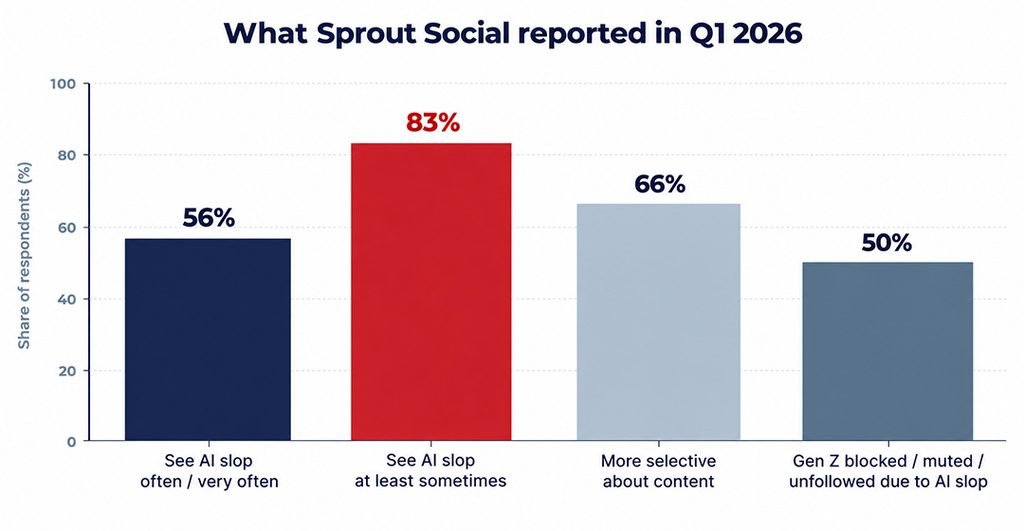
Figure 1. Selected findings from Sprout Social’s Q1 2026 Pulse Survey. Survey population: 2,250 social media users in the US, UK and Australia. [6]
There is an important nuance here. “AI slop” is not simply any content made with AI. Sprout defines the term around mass-produced, often low-quality or pointless content generated at scale. So a polished AI-assisted campaign and a factory of repetitive AI clips are not equivalent.
AI vs. human-made content: which works better?
There is no universal winner because the content job changes. A founder explaining a hard problem, a customer using a product, a chef preparing a dish or a team member sharing first-hand experience creates something AI cannot independently manufacture: evidence that a real person knows, did or experienced something.
At the same time, AI can be the better production choice when the idea is difficult, expensive or impossible to film. Think concept visuals, surreal campaign worlds, rapid creative variations, background extensions, storyboards or early-stage visual exploration.
The useful distinction is therefore not “human versus AI.” It is “where should human judgment remain non-negotiable, and where can AI remove friction?”
A practical content mix for brands
| Content type | Where AI helps | Where humans lead | Recommended approach |
| Real video / UGC | Editing, subtitles, cleanup, repurposing | Story, performance, authenticity | Human-led, AI-assisted |
| Product photos / social graphics | Concepts, variations, backgrounds | Product accuracy, layout, brand system | Hybrid |
| Captions / copy | Research, first drafts, variations | Brand voice, claims, final edit | AI-assisted |
| Expert / educational | Research support, structure | Expertise, experience, original insight | Human-led |
| Fully synthetic video | Visual experimentation | Concept, fact-checking, disclosure | Use selectively; label when required |
When human-made content has the edge
- Proof: real customers, real locations, real products and real results carry context a synthetic scene cannot provide.
- Personality: people follow recognizable voices, not just polished visuals.
- Experience: first-hand stories, opinions and expertise give content a reason to exist beyond the prompt.
- Community: behind-the-scenes footage and employee or creator content can make a brand feel present rather than manufactured.
When AI-generated content can be the better choice
- You need to explore several creative directions before committing to production.
- The idea is difficult or impossible to film safely, quickly or affordably.
- You need multiple versions of a concept for testing, localisation or iteration.
- You are using AI for production assistance while keeping the strategy, facts and final creative decisions human-led.
A 7-step social content workflow for 2026
1. Start with a human insight. Build the content around a real audience question, business problem, customer story or brand point of view.
2. Use AI for acceleration. Generate hooks, outlines, alternative concepts, captions, shot lists or editing ideas – not a complete substitute for creative thinking.
3. Add original source material. Bring in original footage, product photography, first-hand commentary, internal data or subject-matter expertise.
4. Adapt natively to each platform. A TikTok, Reel and YouTube upload should not simply be the same export with a different caption.
5. Review every AI output. Check facts, faces, hands, logos, on-screen text, product details and claims before publishing.
6. Disclose when required. Use the platform’s disclosure or labeling tools for realistic synthetic or meaningfully altered content when the rules require it.
7. Measure business-relevant signals. Look beyond views: retention, completion, replays, saves, shares, qualified leads, enquiries and sales tell you whether the content is doing its job.
Need a content strategy that uses AI without losing the human side?
Partow Ads provides social media strategy, content creation and paid advertising designed around brand goals, audience behaviour and measurable business outcomes.
What about Google and AI-written website content?
The same principle applies beyond social media. Google’s Search Central guidance says generative AI can be useful for research and for adding structure to original content. The risk comes when AI is used to generate many pages primarily to manipulate rankings without adding value for people; Google classifies that pattern under its scaled content abuse policy. [7][8]
That means an AI-assisted article can still be legitimate SEO content. But the more competitive the topic, the more important it becomes to add original reporting, first-hand experience, useful examples, genuine expertise, strong editing and information that a generic model output is unlikely to provide.
Google also published guidance in 2026 emphasizing valuable, unique, non-commodity content for visibility across both classic Search and generative AI features. [8]
Can a brand use AI and still look authentic?
Yes – but authenticity has to come from the substance of the content, not from pretending AI was never involved.
A product campaign can use AI to explore art direction while using real product photography. A founder can use AI to turn a recorded interview into a first draft while keeping the actual voice and experience. A social team can use AI to generate five hooks, then choose one that matches the audience and rewrite it in the brand’s language.
The strongest workflow is usually invisible in the final product because the audience sees a coherent idea, useful information and a clear point of view. They do not need to know which tool helped remove ten minutes of editing friction. They do need honesty when realistic synthetic content could otherwise be mistaken for something real.
Frequently asked questions
Does TikTok suppress AI-generated videos?
TikTok’s current public guidance does not describe a blanket suppression of all AI-generated videos. Instead, TikTok is expanding AI labeling and says it is testing stronger detection of accounts dedicated to AI-generated spam that can crowd out original creators. [5]
Does Instagram reduce reach for AI posts?
Meta’s public updates emphasize original content in Instagram recommendations. Meta reported that, in the US in Q4 2025, 75% of recommendations came from original posts. That does not establish an automatic penalty for every AI-assisted post; it points toward a broader originality and recommendation-quality framework. [2]
Does YouTube penalize AI videos?
YouTube does not say that AI use alone makes a video ineligible for monetization. Its monetization policy does target mass-produced, repetitive or generic content, and its AI disclosure guidance says disclosure itself does not limit audience reach or earning eligibility. [3][4]
Is human-made content always better than AI content?
No. Human-led content is especially valuable when authenticity, proof, lived experience or expertise is the product. AI is especially useful for speed, experimentation and visuals that are hard to produce traditionally. The choice should follow the purpose of the content.
Should brands stop using AI for social media?
There is no evidence in the platform policies reviewed here that brands should stop using AI altogether. A more sustainable model is to use AI for ideation, research support, editing and variations, while humans own strategy, original material, fact-checking, brand voice and final approval.
How can I tell whether my AI content is low-value?
Look for the same symptoms you would monitor in any content: weak retention, little sharing or saving, low completion, limited non-follower reach, weak lead quality and repeated audience drop-off. If a series underperforms, audit the idea and execution before blaming the production tool.
The takeaway for brands in 2026
The evidence does not support the simple idea that “AI content gets less reach.” The more accurate story is that platforms are becoming stricter about originality, repetitive production, spam and misleading synthetic media – while audiences are becoming more selective about what deserves their attention.
That is why the most useful model is not AI-only or human-only. It is human-led, AI-assisted: real ideas, real expertise, real source material and clear creative direction, with AI used where it makes the work faster, more flexible or more ambitious.
For brands, the goal is not to avoid AI. The goal is to avoid becoming indistinguishable.
Build a social strategy around attention – not volume.
Partow Ads combines social media strategy, creative production and paid advertising to help brands turn content into reach, engagement and enquiries.
Sources and references
1. Meta Rewarding Original Creators on Facebook (March 13, 2026).Source ↗
2. Meta 2026: AI Drives Performance (January 28, 2026).Source ↗
3. YouTube Help YouTube channel monetization policies; inauthentic content clarification (July 15, 2025 update).Source ↗
4. YouTube Help Disclosing use of altered or synthetic content.Source ↗
5. TikTok Newsroom Helping people spot and understand AI generated content on TikTok (July 10, 2026).Source ↗
6. Sprout Social Q1 2026 Pulse Survey Analysis; 2,250 users in the US, UK and Australia, fielded Feb. 5-9, 2026.Source ↗
7. Google Search Central Guidance on using generative AI content on your website.Source ↗
8. Google Search Central A new resource for optimizing for generative AI in Google Search (May 15, 2026).Source ↗
Categorise
Tags
#advertising (11) #advertising-agency (6) #advertising-strategies (4) #brand-story (1) Branding (7) digital marketing (7) Marketing (8) partow ads (4) social media campaign (1) Strategies (2)
Recent Posts
- Meta One Malaysia: Pricing, Plus Plans & Business Features

- ChatGPT Ads in Malaysia: Cost, Availability & How It Works?

- Does AI-Generated Content Get Less Reach on Social Media in 2026?
- Trend or Trap? A Brand’s Guide to Choosing Social Media Trends Without Losing Its Identity

- Brand Identity & Brand System: Building a Strong, Consistent Brand



Leave a Reply