

By Partow Ads | Digital Marketing Guide | Updated October 2026
Digital marketing for small business in Malaysia works best when you pick a few channels that match how your customers search and buy, set a realistic budget in ringgit, and track enquiries and sales instead of likes.
Starting a business is one thing. Getting customers consistently is another. You might have a great product, a professional service, or a new website, but if the right people cannot find your business, turning that potential into sales is difficult.
Small businesses in Malaysia have many ways to reach customers: Google Search, social media, WhatsApp Business, online marketplaces such as Shopee and TikTok Shop, and paid advertising. The hard part is knowing which channels to use, how much to spend, and where to start.
The good news is that you do not need to be everywhere online or spend thousands of ringgit on every platform. You need a clear plan that connects your business goals with the right audience, channels, and budget.
In this guide, Partow Ads explains how to build a practical digital marketing strategy for a small business in Malaysia. You will find channel recommendations, sample budgets in RM, a look at government grants that may help, how AI search affects discoverability, and steps you can start today.
In this guide
- Quick answer: how to start
- 1. Define your business goals
- 2. Identify your target audience
- 3. Choose the right platforms
- 4. Set your budget: RM1,000, RM3,000 or RM5,000
- 5. Check whether a government grant can help
- 6. Website, landing page or online store
- 7. Get found on Google and in AI search
- 8. Organic marketing vs paid ads
- 9. Measure results and improve
- Common mistakes to avoid
- Frequently asked questions
Quick Answer: How Should a Small Business Start Digital Marketing in Malaysia?
If you are new to digital marketing, start with these five steps:
- Define your target audience and the problem your business solves.
- Choose one primary marketing channel based on how customers discover and buy your type of product or service.
- Set up a professional website or landing page, or improve your existing online presence.
- Start with a manageable budget and test your marketing approach.
- Track enquiries, sales, and customer acquisition costs instead of focusing only on views and likes.
For example, a local service business may benefit from Google Search and Google Business Profile, while a visual consumer brand may start with Instagram or TikTok. An online store may combine an e-commerce website with marketplace listings and paid advertising.
No single marketing channel works best for every business. The right choice depends on your audience, offer, competition, and available resources.
1. Define Your Business Goals Before Choosing a Marketing Channel
One of the most common mistakes small businesses make is choosing a platform before deciding what they want their marketing to achieve.
More followers are not the same as more customers, and website visits do not guarantee sales. Start by identifying your main business objective.

Start with a clear business objective before selecting marketing channels.
| Your business goal | What to focus on | Possible channels |
| Increase local awareness | Reach relevant people nearby | Google Business Profile, Instagram, Facebook |
| Generate enquiries | Encourage calls, messages, or form submissions | Google Search Ads, Meta Ads, landing pages |
| Sell products online | Drive qualified product visits and purchases | E-commerce website, Shopee, TikTok Shop, Meta Ads |
| Attract B2B clients | Reach decision-makers and build credibility | LinkedIn, Google Search, professional website |
| Build long-term visibility | Attract people searching for relevant information | SEO, helpful blog content, local SEO |
| Encourage repeat purchases | Stay connected with existing customers | WhatsApp Business, email marketing, loyalty programmes |
Think about what a successful result looks like for your business. A restaurant may want more reservations. A consultant may need qualified enquiries. A retailer may measure completed purchases and repeat orders. Once the goal is clear, choosing the right channel becomes much easier.
2. Identify Your Target Audience: Who Are You Trying to Reach?
You can run an excellent campaign and still get poor results if it reaches the wrong people. Before spending money on advertising, define the customers most likely to need and pay for your product or service.

A clear customer profile helps shape more relevant content and campaigns.
Build a simple customer profile
- Who are they? Think about their needs, buying role, location, and relevant characteristics.
- Where are they? Are they searching on Google, browsing Instagram, watching TikTok videos, or shopping on online marketplaces?
- What problem do they have? What are they trying to solve?
- What influences their decision? Price, convenience, reviews, quality, expertise, or trust?
- What action should they take? Call, send a WhatsApp message, book a consultation, or buy online?
For a B2B business in Kuala Lumpur, the audience might be business owners or marketing managers looking for professional services. For a beauty brand, it may be consumers who discover products through short videos, creators, reviews, and online shopping platforms. These businesses need different messages, content, and distribution strategies.
Consider Malaysia’s multilingual market
Malaysia has a diverse audience. Depending on your industry and customers, English, Bahasa Malaysia, Mandarin, or other languages may be relevant. You do not need content in every language. Start with the language your customers prefer, and test additional versions when there is a clear business reason.
For example, a service provider targeting English-speaking corporate clients may prioritize English website content and LinkedIn. A consumer brand targeting a broader local audience may test Bahasa Malaysia content alongside English creative. Use actual enquiries, customer feedback, and campaign data to guide language decisions rather than assumptions about an entire demographic.
Create different messages for different customer needs
Imagine you offer website design services. One potential customer may be searching for an affordable website for a new business. Another may have an outdated website that generates few enquiries. A third may need an online store.
All three need website services, but their motivations differ. Your content and advertising should address these differences through relevant landing pages, examples, offers, and calls to action.
3. Which Digital Marketing Platforms Should Your Small Business Use?
You do not need to be active on every platform. Start where your customers are most likely to discover your business or make a purchase.
Google Search and Google Business Profile
Google is particularly useful when potential customers are actively looking for a product or service. Searches such as “web design company in Kuala Lumpur,” “accounting services near me,” or “cafe near Bukit Bintang” signal a specific need. To show up for them, you will typically want:
- A professional website with clear service pages.
- Search engine optimization (SEO) for relevant queries.
- A complete and accurate Google Business Profile, if your business is eligible.
- Customer reviews and accurate business information.
- Google Search Ads when you want to test demand for relevant keywords.
Google also explains how to manage your details in its official guide to business information in Search.
Instagram and Facebook
Instagram and Facebook can help businesses build awareness, showcase products, share customer experiences, and generate enquiries. They may suit restaurants, cafes, beauty and lifestyle brands, and professional services that benefit from visual proof and testimonials.
For more detail, read our guide: Meta Ads Objectives: How to Choose the Right Campaign Objective?
TikTok
TikTok can help brands reach audiences through short-form video, demonstrations, product discovery, creator content, and storytelling. It may be worth testing if your product or service can be communicated well on video.
However, views alone do not prove a campaign is profitable. Track meaningful actions such as qualified enquiries, product page visits, purchases, and the cost of acquiring a customer.
For B2B businesses, consultants, professional service providers, and companies targeting decision-makers, LinkedIn can support professional visibility and relationship-building. You can publish expert content, share case studies, take part in relevant discussions, and use paid campaigns where the audience and budget justify them.
WhatsApp Business
WhatsApp Business helps customers ask questions, request quotations, and talk directly with your team. It works well as a contact and customer communication channel, but it is not a replacement for your entire marketing strategy.
A potential customer might find your business through Google, see your portfolio on Instagram, and then contact you on WhatsApp. Make sure the journey is clear and your team responds promptly. Promotional messages should also follow consent requirements under Malaysia’s Personal Data Protection Act 2010 (PDPA) and any other applicable rules.
Shopee, Lazada, and TikTok Shop
For product-based businesses, online marketplaces and social commerce offer additional routes to customers. Marketplaces provide existing shopping infrastructure, while your own e-commerce website gives you more control over your brand experience and website content. Compare platform fees, fulfilment requirements, competition, customer experience, and the role each channel should play in your sales strategy.

Online stores and marketplaces can complement one another in a small-business sales strategy.
An Ipsos Malaysia survey on the 2026 e-commerce landscape found that, among Malaysians who had bought online in the previous six months, 71% had shopped on Shopee and 62% on TikTok Shop. These figures describe that survey’s respondents (surveyed in May 2026), not every Malaysian consumer.
Quick decision guide: Which platform should you choose?
| If your business is… | Consider starting with… | Primary action to measure |
| A local restaurant or cafe | Google Business Profile + Instagram | Calls, directions, bookings |
| A professional service provider | Website + Google Search | Qualified enquiries |
| A B2B company | Website + LinkedIn or Google Search | Relevant leads and meetings |
| A visual consumer brand | Instagram or TikTok | Product interest and purchases |
| An online retailer | E-commerce website + suitable marketplaces | Orders and profit contribution |
| A new business with limited resources | One relevant channel + a clear online presence | Initial customer enquiries |
Treat this as a starting point, not a fixed formula. Test the channels that fit your customers and business model.
4. How Much Should a Small Business Spend on Digital Marketing in Malaysia?
Your marketing budget should reflect what you can afford to test, the value of a new customer, and the resources needed to turn an enquiry into a sale.
No universal percentage of revenue or fixed monthly amount works for every business. For an early-stage business, it is often more practical to start with one primary channel, measure the results, and expand when the data supports it.
Example monthly budgets: RM1,000, RM3,000, and RM5,000
A practical way to plan is to choose a monthly total, such as RM1,000, RM3,000 or RM5,000, and split it across advertising, content, and tracking. The allocations below are illustrative planning scenarios, not guaranteed performance recommendations or fixed market rates.
| Monthly budget | Paid advertising | Content and creative | Website, tracking and optimization |
| RM1,000 | RM600 | RM250 | RM150 |
| RM3,000 | RM1,500 | RM900 | RM600 |
| RM5,000 | RM2,500 | RM1,500 | RM1,000 |

Example monthly digital marketing budget splits in RM. Illustrative planning scenarios only, not market benchmarks.
Want to share this chart? You are welcome to, with a credit and link back to this guide from Partow Ads.
Each scenario adds up to the stated monthly total. Actual costs depend on your scope, the channels selected, and whether your website and creative assets are already ready. If you work with an external marketing team, confirm whether its management fee sits inside these totals or is charged on top.
What should you do with RM1,000 per month?
With RM1,000 a month, focus on one primary channel only. Google Search suits service businesses whose customers search for a solution. Instagram or TikTok suits visual consumer brands. From there:
- Choose one primary channel based on customer behaviour.
- Use existing brand assets where possible.
- Create a small set of useful content rather than trying to publish everywhere.
- Test one clear offer or campaign.
- Measure enquiries, sales, and the quality of incoming leads.
If you choose paid advertising, remember that media spend is only one part of the total cost. Creative production, campaign management, website changes, and tracking may need additional resources.
What changes with RM3,000 per month?
A larger budget may let you combine advertising with more consistent content and landing-page improvements. A service business could test Google Search Ads while improving its service pages. A consumer brand could test a Meta campaign and produce new creative based on the strongest-performing messages.
Do not split the budget across many platforms simply because the money is available. Each channel needs enough resources to produce useful learning.
What if you have RM5,000 per month?
- Test a primary channel before adding another.
- Improve landing pages and conversion tracking.
- Produce multiple creative variations.
- Retarget eligible audiences where appropriate.
- Compare lead quality and sales outcomes, not only cost per click.
If you already have a working campaign, base additional investment on its economics and capacity to scale, rather than on budget alone.
Understand the difference between ad spend and service fees
- Media spend: money paid to advertising platforms such as Google or Meta.
- Management fee: strategy, campaign setup, monitoring, optimization, and reporting.
- Creative production: design, photography, video, copywriting, or other campaign assets.
- Website and tracking: landing pages, development, analytics, and conversion measurement.
These costs may be combined or quoted separately, so compare the actual deliverables rather than the headline price. Published prices vary widely by provider, scope, and service level, so ask for an itemised quote before you compare.
Not sure how to allocate your marketing budget? Partow Ads can help you assess your goals, current online presence, and potential marketing channels before you commit to a plan. Explore Partow Ads and enquire about a strategy consultation.
5. Can the Government Help Pay for Your Digital Marketing?
Many small business owners never ask this question, yet the answer can change the budget. One programme to check is the MSME Digital Grant MADANI. According to Bank Simpanan Nasional (BSN), it offers a matching grant of up to 50% of the invoice amount, capped at RM5,000, for digital solutions bought from providers on an MDEC-approved list. Digital marketing and sales is one of the categories it covers.
For example, on a RM6,000 invoice the grant would be RM3,000 and you would pay the remaining RM3,000. On a RM10,000 invoice, the grant would reach the RM5,000 cap. Before you build your budget around it:
- Check eligibility on the official page. Requirements usually cover business registration and size, and businesses that already received a digitalisation matching grant may not qualify. Read the criteria on BSN’s MSME Digital Grant MADANI page.
- Confirm that funding is still available. Grant allocations are limited and rules can change, so verify the current status instead of relying on older articles.
- Use an approved provider. The grant applies to services from MDEC-certified digitalisation partners. Ask any agency whether it is on the current list before you sign.
- Be careful with guarantees. Approval decisions rest with the programme administrators, so treat any provider that guarantees approval with caution.
A grant can stretch a small budget, but it does not replace a plan. You still need a clear goal, a tracked channel, and a website that turns visitors into enquiries.
6. Do You Need a Website, a Landing Page, or an E-commerce Store?
Your website is not just an online brochure. It can explain your offer, answer customer questions, build trust, and turn interest into enquiries or sales. The right setup depends on what you sell.
A business website
A service-based company may need pages that explain its services, expertise, portfolio, process, and contact options. A well-structured website supports SEO and gives customers a reliable place to evaluate your business.
A landing page
A landing page focuses on a specific offer or campaign. It is useful when you want visitors to take one clear action, such as requesting a quotation, booking a consultation, or registering for an event.
For paid advertising, make sure the landing page matches the promise in the ad. If someone clicks an ad about a specific service, they should arrive at a page that explains that service clearly.
An e-commerce website
An online store needs more than attractive product images. Customers should be able to understand product details, compare options, see delivery and return information, and complete checkout confidently.
Before investing in an e-commerce website, plan your product catalogue, payment methods, shipping, inventory, customer support, and marketing strategy. You can also compare your own store with marketplaces such as Shopee, Lazada, and TikTok Shop.
What makes a website more effective?
- Mobile-friendly design and clear navigation.
- Fast, reliable page loading.
- Useful content that answers customer questions.
- Clear calls to action.
- Trust signals, relevant reviews, and accurate business information.
- Analytics and conversion tracking.
- A straightforward way to contact or buy from you.
Read our guide: SEO-Friendly Website Design: How to Build a Website That Ranks in Google.
Partow Ads provides website design and development services in Malaysia, including business websites, WordPress solutions, and e-commerce development.
Need a website that supports your marketing goals? Discuss your requirements with Partow Ads and explore a solution that fits your business, budget, and customer journey. Visit Partow Ads to enquire about website design
7. How to Get Found on Google and in AI Search Answers
More people now get answers from AI features inside search, such as Google’s AI Overviews and AI Mode, as well as from AI assistants. For a small business, the practical question is simple: how do you stay visible?
Google’s own guidance says that optimizing for its generative AI features is still SEO. The same fundamentals apply: pages that can be crawled and indexed, and helpful, original content. Google also states that no special markup or extra files are required to appear in these features. This guidance covers Google’s products, and other AI assistants may work differently, but the habits below help in every case. See Google’s guide to optimizing your website for generative AI features for the full detail.
A practical SEO, GEO and AEO checklist for small businesses
- Answer real questions clearly (AEO). Put a short, direct answer under each question-style heading, then add detail. It helps readers and makes your page easy for search systems to understand.
- Make key pages indexable. Use Google Search Console to confirm that your service pages are indexed and not blocked.
- Keep business details consistent. Use the same name, address, phone number, and opening hours on your website, Google Business Profile, social profiles, and directories.
- Show real expertise and proof. Original photos, case studies, team details, and genuine customer reviews give search systems and customers a reason to trust you.
- Use internal links. Link related articles and service pages to each other with descriptive anchor text so visitors and search engines understand how your content connects.
- Earn external links naturally. Mentions from relevant, reputable sites such as industry associations, suppliers, partners, local directories, and media features support credibility. Buying links to manipulate rankings goes against Google’s spam policies.
- Link out to trustworthy sources. When you cite data or official guidance, link to the original so readers can verify it.
- Write titles and descriptions the way people search. A page titled “Web Design Company in Kuala Lumpur” matches real searches better than a vague brand slogan.
- Use structured data where it fits. LocalBusiness, Product, and FAQ markup can help machines read your pages, but make sure it matches the visible content.
SEO is a long-term investment, and no one can promise a particular ranking. Done consistently, it builds visibility that does not stop when your ad budget does.
8. Organic Marketing vs Paid Ads: Which Should You Choose?
Organic marketing and paid advertising serve different purposes, and many businesses benefit from using both over time.
Organic marketing includes SEO, helpful blog content, organic social media posts, and community engagement. It can build long-term visibility, but results often need consistency and time. Paid advertising can help you reach a defined audience or test an offer more quickly, but it requires budget and does not guarantee sales.
| Factor | Organic marketing | Paid advertising |
| Direct media cost | No advertising charge for organic distribution, but production and management still cost time or money | Requires a media budget |
| Speed | Often takes time to build consistent reach or search visibility | Can generate exposure soon after launch and approval |
| Long-term value | Useful content and search visibility can continue attracting visitors | Results depend on continued campaigns, audience demand, and performance |
| Control | Reach depends on search systems, platforms, and audience response | More control over campaign settings, budget, and audience options |
| Best suited for | Building credibility and sustained discoverability | Testing offers, reaching selected audiences, and pursuing specific outcomes |
When should you invest in organic marketing?
Organic marketing may be a priority if you want to build authority, attract search traffic, and establish a consistent presence over time. A professional service business, for example, could publish helpful articles, improve its service pages, and maintain an accurate Google Business Profile.
When should you consider paid advertising?
Paid campaigns may be useful when you have a clear offer, a defined audience, a suitable landing page, and a way to measure results. A business that needs enquiries may test Google Search Ads for relevant searches or Meta Ads for an appropriate audience and offer.
Before launching, select a campaign objective that matches the outcome you want. Our guide explains the process: Meta Ads Objectives: How to Choose the Right Campaign Objective?
Can you combine organic and paid marketing?
Yes. A business might use SEO and social content to build a long-term presence while running a limited paid campaign to test a specific service. Use the results to decide what to improve next.
Paid campaigns can provide useful audience and creative feedback, while organic content can answer questions and support customers who are researching their options. The best mix depends on your business model, resources, sales cycle, and objectives.
9. Measure Results and Improve Your Marketing Strategy
Judge digital marketing by more than views, likes, or impressions. Those metrics show reach and engagement, but business performance depends on whether the right people take meaningful actions.
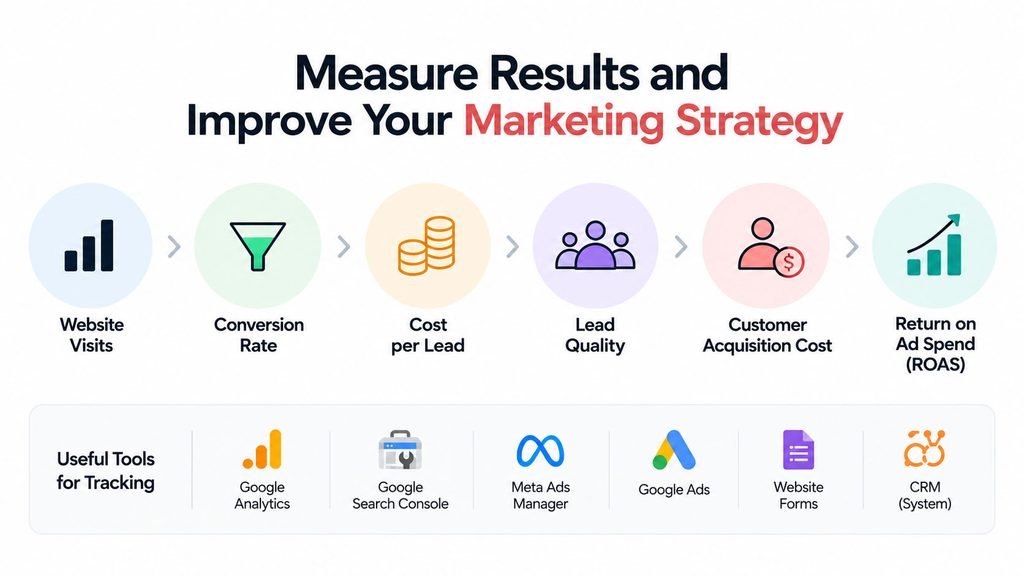
Review enquiries, sales, and lead quality, not only clicks and likes.
| Metric | What it tells you |
| Website visits | Whether people are reaching your website |
| Conversion rate | The percentage of visitors who complete a defined action |
| Cost per lead | How much you spend to generate an enquiry or lead |
| Lead quality | Whether the enquiries match your target customers |
| Customer acquisition cost | The cost of acquiring a paying customer |
| Return on ad spend (ROAS) | Revenue attributed to advertising relative to ad spend |
A campaign that generates many clicks but few qualified enquiries may have an audience, offer, or landing-page problem. A campaign with fewer leads may be more valuable if those leads are relevant and convert into profitable customers.
Set up suitable analytics and conversion tracking before launching major campaigns. Depending on your business, this may include Google Analytics, Google Search Console, advertising platform reporting, website forms, or a CRM.
Give each test enough time to collect meaningful data before you judge it, and review the numbers regularly. Make one or two meaningful changes at a time, so it is easier to see what is helping or hurting performance. For ad campaigns, Meta Blueprint offers a free lesson on how to set measurable goals and choose an ad objective.
6 Common Digital Marketing Mistakes Small Businesses in Malaysia Should Avoid
- Picking a platform before a goal. Decide what success looks like first, then choose the channel.
- Boosting posts with no tracking. Without enquiry or sales tracking, you cannot tell what worked.
- Sending ad traffic to the homepage. Send visitors to a page that matches the ad and offers one clear next step.
- Replying slowly on WhatsApp. A lead that waits for hours may already have contacted a competitor.
- Spreading a small budget across too many channels. Fund one channel properly before adding another.
- Changing everything at once. Change one or two things at a time so you can see what made the difference.
Your Small Business Digital Marketing Checklist
- I have a clear business goal for my marketing.
- I understand who my ideal customers are.
- I know which channels my customers are likely to use.
- I have a clear offer and a reason for customers to choose my business.
- My website or business profile contains accurate information.
- I have a clear call to action.
- I have decided how much I can spend and what that budget includes.
- I have checked whether a government grant could apply.
- I can track enquiries, sales, or other meaningful conversions.
- I have a plan to review results and improve the campaign.
Frequently Asked Questions
What is the best digital marketing strategy for a small business in Malaysia?
No single strategy suits every business. Start with a clear customer profile, select one or two relevant channels, build a credible online presence, and measure enquiries or sales. Expand based on evidence rather than assumptions.
How much does digital marketing cost for a small business in Malaysia?
Costs vary by channel, scope, competition, and level of support. A practical start is to set a manageable monthly total, such as RM1,000, RM3,000 or RM5,000, and separate advertising spend from service fees. See the example budget splits in section 4 of this guide.
How can I get more customers online in Malaysia?
Make it easy for potential customers to discover, understand, and contact your business. Depending on your industry, that may involve SEO, Google Business Profile, social media, paid advertising, online marketplaces, or a professional website. A clear offer and a straightforward customer journey are essential.
Should I use Google Ads or Meta Ads?
Google Search Ads work well when customers actively search for a solution. Meta Ads can reach relevant audiences through Facebook and Instagram placements. Choose based on customer behaviour, campaign objectives, creative assets, and conversion tracking.
What is the best social media platform for small business in Malaysia?
It depends on your customers. Facebook and Instagram suit broad local reach and visual proof, TikTok suits short-video product discovery, LinkedIn suits B2B, and WhatsApp suits direct conversations. Start where your customers already spend time, then test one platform properly.
Do I need a website if I already use Instagram or Shopee?
Not every business needs a full website immediately, but a website gives you more control over your brand presentation, content, customer journey, and direct enquiries. Marketplaces and social platforms can complement your website rather than replace it.
Can I get a government grant for digital marketing in Malaysia?
Possibly. The MSME Digital Grant MADANI, administered through Bank Simpanan Nasional with MDEC-approved providers, offers a matching grant of up to 50% of the invoice, capped at RM5,000, and digital marketing and sales is one of its categories. Check eligibility and current funding availability on the official BSN page before you apply.
How long does SEO take to produce results?
SEO timelines depend on your website, competition, content quality, and technical condition. Some improvements may be processed sooner than others, but meaningful organic growth generally requires ongoing work. No provider can guarantee a particular ranking or timeline.
Do I still need SEO now that people use AI search?
Yes. Google says optimizing for its AI Overviews and AI Mode is still SEO, built on crawlable, helpful, original content. Clear answers, accurate business details, and trustworthy sources help you in both traditional and AI-powered search.
Is digital marketing worth it for a small business?
It can be, when you can track what it brings in. It is worth the spend if the profit from a new customer is higher than the cost of acquiring them. Start small, measure enquiries and sales, and scale only what works.
Ready to Build a Digital Marketing Strategy for Your Business?
Growing a small business online is not about using every platform or following every new trend. It is about understanding your customers, choosing the right channels, communicating a clear offer, and improving your marketing based on results.
Whether you need a professional website, social media support, SEO, or a more structured digital marketing plan, the first step is to understand what your business needs most.
At Partow Ads, we combine website design and development, SEO and content marketing, social media, branding, and digital marketing strategy to help businesses strengthen their digital presence.
Visit Partow Ads to enquire about a strategy consultation and discuss the next steps for your business.
Want to know where your business should start?
Your next customer may already be searching. Make it easier for them to find you.
Sources and Further Reading
- Google Search Central: Optimizing your website for generative AI features on Google Search
- Google Search Central: AI features and your website
- Google Search Central: Business details in Search
- Bank Simpanan Nasional: MSME Digital Grant MADANI
- Ipsos Malaysia: E-commerce Landscape in 2026
- Meta Blueprint: Measurable business goals and ad objectives
- Google Business Profile
- Google Search Console
Categorise
Tags
#advertising (11) #advertising-agency (6) #advertising-strategies (4) #brand-story (1) Branding (7) Marketing (8) narrative-driven branding (1) partow ads (4) social media campaign (1) Strategies (2)
Recent Posts
- Go-to-Market (GTM) Strategy in Malaysia

- Digital Marketing for Small Business in Malaysia: 2026 Guide (With RM Budgets)
- Exhibition Checklist Malaysia: Booth, Printing, Gifts & Costs (2026)

- Why Your Website Gets Traffic but No Leads: 10 Conversion Problems to Fix

- Meta One Malaysia: Pricing, Plus Plans & Business Features



Leave a Reply