
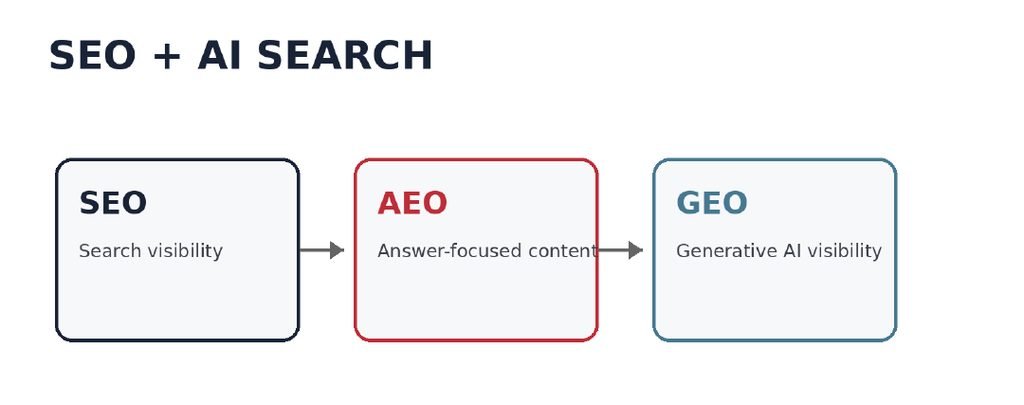
SEO is still the foundation, AEO and GEO just describe how that foundation shows up in AI-powered search.
Search Hasn’t Changed. The Way People Ask Has.
Ask ten business owners what “AEO” means and you’ll get ten different answers — and at least three nervous jokes about whether Google is about to become obsolete. It isn’t. But the way people search is shifting fast, and if your website is still built for 2015-style keyword hunting, you’re leaving visibility on the table.
People now type full questions into search bars, ask AI tools to compare options for them, and expect an answer, not just ten blue links. That shift is why terms like Answer Engine Optimization (AEO), Generative Engine Optimization (GEO), and AI search optimization have started showing up everywhere in digital marketing conversations.
Here’s the part most of that noise skips: none of these are secret systems replacing SEO. Google’s own guidance says its AI search experiences still rely on core Search ranking and quality systems. Strong SEO fundamentals are still doing the heavy lifting, AEO and GEO just describe how that work shows up inside AI-powered results.
So the practical goal for a business website stays refreshingly simple: create genuinely useful information, make it easy for machines to crawl and understand, answer the questions your real customers are actually asking, and build enough authority that people, and the search systems reading on their behalf, trust what you’ve published.
So What Is AEO, Really?
AEO stands for Answer Engine Optimization. In plain terms, it’s industry shorthand for shaping your content so answer-focused and AI-powered search experiences can understand it, and confidently serve it up as the answer.
Instead of writing only for a short keyword like “web design Malaysia,” an AEO-aware content strategy also thinks in questions: “What should a business website include?” or “How much does website design cost in Malaysia?”
The goal isn’t to stuff every page with question-shaped headings. It’s to genuinely understand the problems your customers are trying to solve, and answer them clearly enough that both a human and an AI system can follow along.
SEO vs AEO vs GEO, Side by Side
| SEO | AEO | GEO |
| Broad search visibility | Answer-focused visibility | Generative AI visibility |
| Technical SEO + content | Questions + clear answers | Content + authority + AI discovery |
| Search results | Answer-oriented experiences | AI-generated responses |
These terms overlap far more than they compete. Google itself notes that AEO and GEO describe activities aimed at improving visibility in AI-powered search, while treating generative AI search optimization as part of SEO, not a replacement for it.
You may also see AIO (AI Optimization) used in the wild. It’s applied less consistently across the industry, so treat it as a broad descriptive term rather than a distinct Google ranking system.
The Same Person, Four Different Searches
Picture one potential customer, at four different moments, all looking for the same thing:
- Traditional search: “web design Malaysia”
- Question-based search: “How much does website design cost in Malaysia?”
- Conversational search: “What should a small business look for in a web design company?”
- AI-assisted research: “I’m starting a business in Malaysia. What type of website should I build and what should I budget for?”
Same intent, four completely different phrasings. A content strategy built only around isolated keywords will miss three of these four moments. A strategy built around real customer questions, comparisons and decisions catches all four.
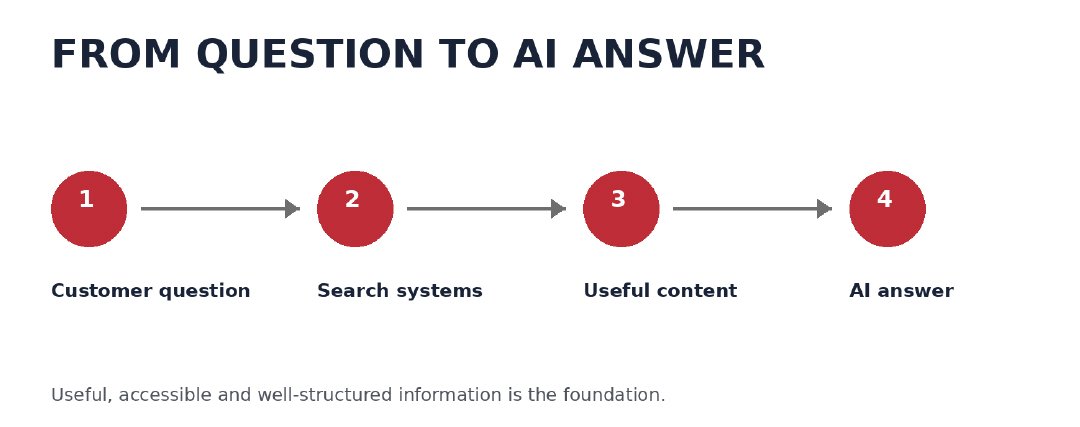
A simple model of how useful website content feeds AI-powered search experiences.
7 Practical Ways to Improve AI Search Visibility
1. Answer real customer questions, early
Put the answer near the top of the relevant section, then explain it in more depth below. This improves usability without turning the page into a wall of keyword variations.
2. Use headings that actually map to the topic
One clear H1, logical H2/H3 sections underneath. Good headings let visitors scan the page in five seconds, and let search systems understand your structure just as fast.
3. Write something only you could write
Add first-hand experience, local examples, case studies, original research, or a practical checklist, anything genuinely useful. Mass-produced, generic AI-written pages are easy to spot, and easy to skip.
4. Strengthen internal links
Connect related blog posts, service pages and guides using descriptive anchor text. This helps visitors discover more of what you offer, and gives search engines a clearer map of your site.
5. Keep pages crawlable and indexable
Make sure important pages are actually reachable, not accidentally marked noindex, using clean URLs, and included in a working sitemap. None of the content work above matters if a page can’t be found.
6. Don’t make people fight your website
Fast loading, responsive design, readable typography, clear navigation and optimized images all support a strong technical SEO foundation, and a visitor who actually sticks around.
7. Earn real authority, not shortcuts
Build relevant mentions and backlinks through useful resources, original data, industry contributions, partnerships and digital PR. Skip the low-quality links that exist purely to manipulate rankings, they tend to do more harm than good.
Internal Linking for a Stronger Content Cluster
This article connects naturally to our SEO-friendly website design guide and our Website Design & Development service.
It also supports our Website Design Cost in Malaysia article and our Effective Landing Pages guide.
Use descriptive anchor text instead of generic phrases like “click here.” Google recommends making links understandable to both users and search engines, and it simply reads better too.
Backlinks: What Actually Helps?
A backlink is a link from another website to yours. AEO doesn’t create backlinks automatically, but a strong article can absolutely be built to earn them.
Useful backlink-worthy assets include original research, local market data, calculators, checklists, case studies, expert commentary and genuinely useful guides. The goal is simple: publish something another website has a real reason to reference.
Steer clear of low-quality directories, automated link building, excessive link exchanges and similar tactics aimed mainly at manipulating rankings. Google’s spam policies specifically address link spam, and the risk rarely outweighs the reward.
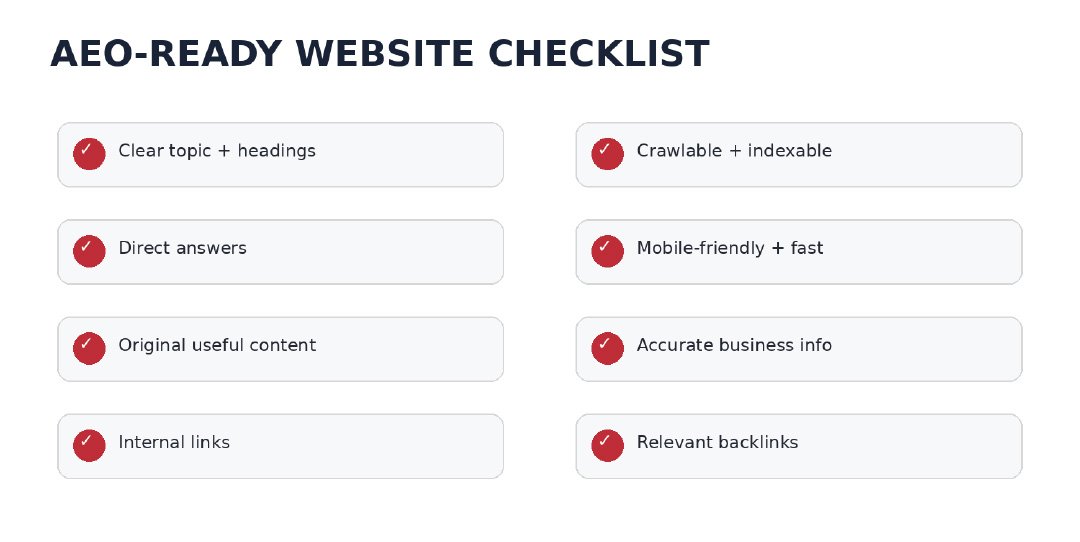
A practical checklist for reviewing important pages before you hit publish.
AEO for Malaysian Businesses
If you’re serving Malaysian customers, make your location, services and audience unmistakably clear. Depending on the business, that might mean useful content around searches such as “SEO Malaysia,” “website design Kuala Lumpur,” “AEO Malaysia,” “AI search optimization Malaysia,” or “digital marketing Malaysia.”
What it shouldn’t mean is dozens of near-identical location pages built purely to capture keyword variations. Every page needs a genuine purpose and real local information — or it’s just noise.
What Should Businesses Actually Focus On in 2026?
Stop thinking of this as SEO versus AEO. Build a strong SEO foundation, and make the content genuinely useful for conversational and AI-assisted search on top of it.
A practical priority order: technical accessibility → useful content → clear structure → internal linking → authority and relevant backlinks → measurement and continuous improvement.
Quick AEO Checklist
- Clear page topic and descriptive H1
- Direct answers to real customer questions
- Original and useful content
- Logical H2/H3 structure
- Relevant internal links
- Crawlable and indexable pages
- Mobile-friendly experience
- Optimized images and performance
- Accurate business information
- Relevant, trustworthy backlinks
FAQs
What is AEO?
AEO stands for Answer Engine Optimization. It’s commonly used to describe content practices aimed at improving visibility in answer-focused and AI-powered search experiences.
Is AEO the same as SEO?
No. AEO is an industry term focused more specifically on answers and AI-powered search experiences, while SEO covers the broader process of improving search visibility. The two overlap heavily.
Does AEO replace SEO?
No. Google’s current guidance says its AI search experiences rely on core Search ranking and quality systems, so SEO fundamentals remain essential.
How can I optimize my website for AI search?
Start with crawlable pages, useful original content, clear answers, logical headings, strong internal linking, good performance and genuine authority.
Can AEO help a Malaysian business?
Yes, as part of a broader SEO and content strategy, particularly since customers increasingly use conversational questions to research local businesses and services.
Ready to Improve Your Search Visibility?
At Partow Ads, we combine web design and development with SEO and digital marketing to help businesses build websites that are genuinely useful for people — and easy to discover through modern search.
Want your website to show up in Google and AI-powered search? Book a free consultation with Partow Ads, and let’s map it out together.
Recommended Sources
Categorise
Tags
#advertising (11) #advertising-agency (6) #advertising-strategies (4) #brand-story (1) Branding (7) digital marketing (7) Marketing (8) partow ads (4) social media campaign (1) Strategies (2)
Recent Posts
- Meta One Malaysia: Pricing, Plus Plans & Business Features

- ChatGPT Ads in Malaysia: Cost, Availability & How It Works?

- Does AI-Generated Content Get Less Reach on Social Media in 2026?

- Trend or Trap? A Brand’s Guide to Choosing Social Media Trends Without Losing Its Identity

- Brand Identity & Brand System: Building a Strong, Consistent Brand



Leave a Reply