

A trending TikTok sound suddenly appears everywhere. A new Instagram Reel format starts dominating your feed. A meme becomes popular overnight. Then someone on your marketing team asks: “Should we do this too?”
The honest answer isn’t yes or no. For brands, following every trend can make content feel repetitive, forced, or disconnected from the brand. Ignoring every trend can make a brand feel out of touch with how audiences actually consume content today.
The real skill isn’t spotting trends. It’s knowing which ones are worth your brand’s time, and which ones you should scroll straight past.
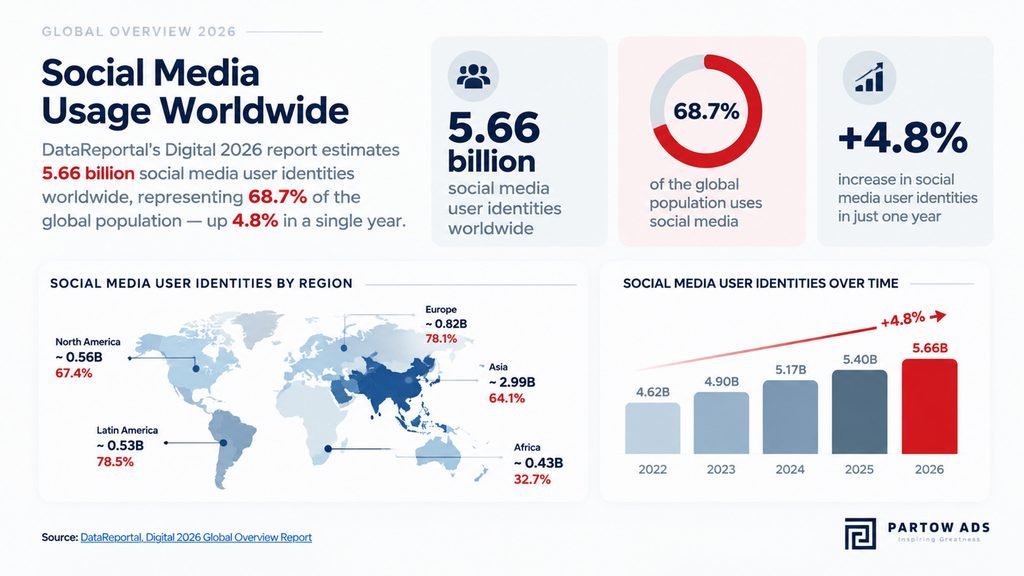
Note: this figure counts “user identities,” not confirmed unique human beings — one person can hold several accounts across platforms. Even accounting for that, the scale is enormous.
More people, more platforms, more trends, and more noise. So the real question for any brand is no longer “what’s trending?” It’s “what’s trending that actually makes sense for us?”
What Is a Social Media Trend, Exactly?
A social media trend is a format, sound, topic, visual style or behaviour that sees a sudden, noticeable spike in attention or adoption on a platform. That can include trending audio, viral video formats, memes, challenges, hashtags, editing styles and storytelling structures.
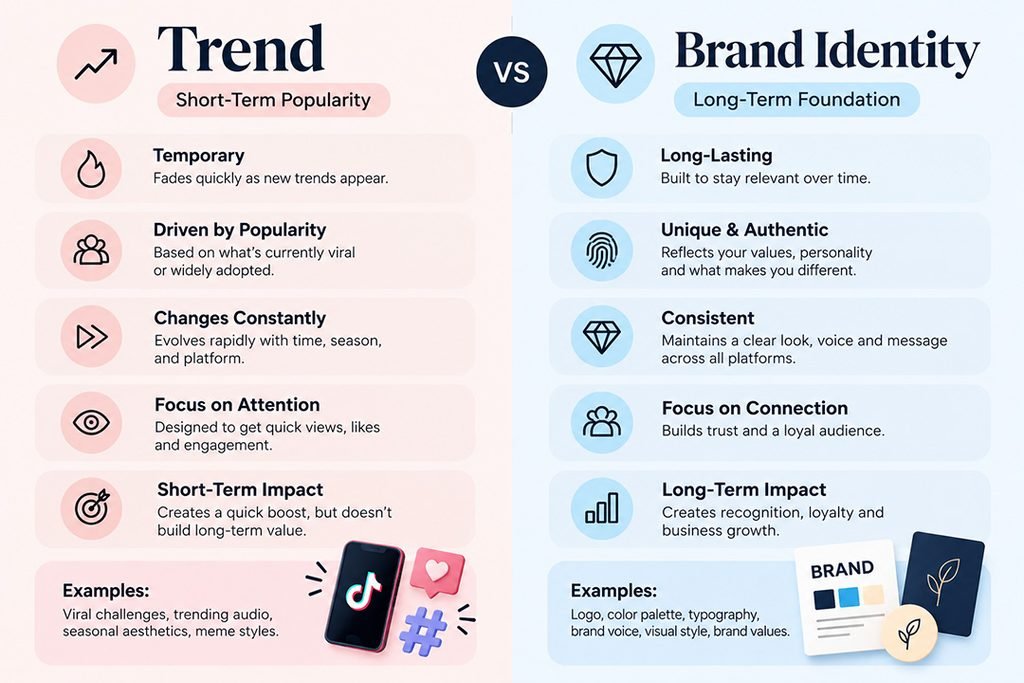
But here’s the nuance most brands miss: not everything that goes viral is a trend worth following. A single video can rack up millions of views without creating a repeatable format. A genuine trend creates a pattern, one that other creators and users start adopting too.
That distinction matters because the goal was never to copy whatever has the most views. It’s to spot patterns that are genuinely relevant to your audience, and adaptable to your brand.
Why Do Trends Matter for Brands?
Platforms are constantly changing how people discover, consume and engage with content. And audience expectations differ from network to network, treating social media as one single channel is one of the fastest ways to waste a content budget.
A working content strategy needs two things at once:
- Brand consistency: so people recognise you wherever they find you
- Platform relevance: so your content doesn’t feel out of place on the app it’s living on
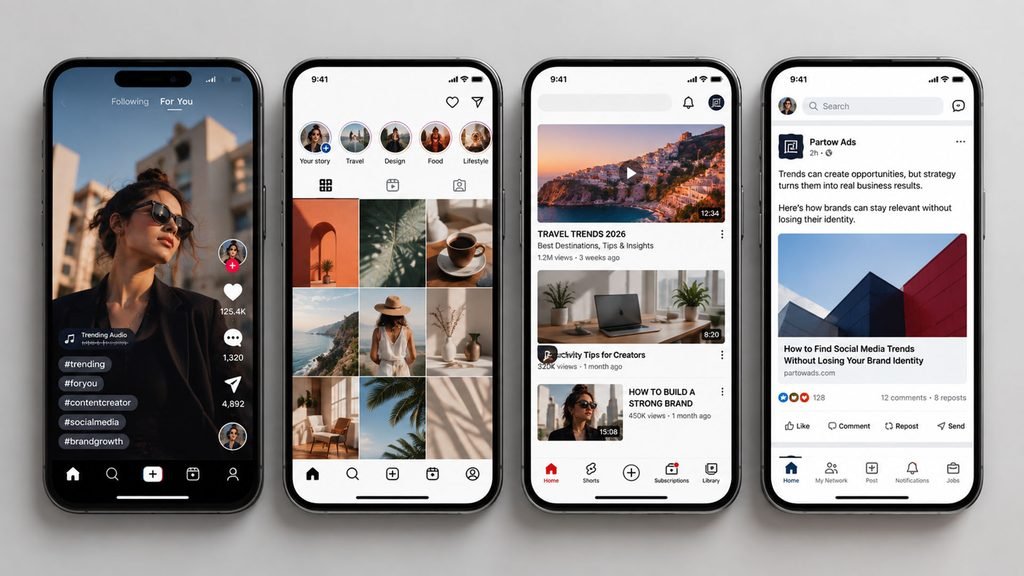
The same brand might show up as a fast, creator-style video on TikTok, a polished carousel on Instagram, an educational long-form video on YouTube, and an expert opinion post on LinkedIn. The brand doesn’t change. The execution does.
Should Brands Follow Every Trend? Not Necessarily, Here’s the Difference
Strong brands don’t need to build their identity around trends. They can adapt relevant trends to their existing identity instead. That’s a subtle but important difference, and it’s the line between trend chasing and trend strategy.
| Trend Chasing | Trend Strategy |
| “Everyone is doing this. Let’s do it too.” | “Our audience is engaging with this. Can we use the idea in a way that fits our brand?” |
| Copies the original format exactly | Adapts the format to the brand’s own voice |
| Measures success in views | Measures success against a business objective |
| Same execution on every platform | Platform-specific execution |
| Changes the brand to fit the trend | Protects the brand while using the trend |
| Hopes it goes viral | Creates with a clear purpose |
Brand Identity Comes First. Trends Come Second.
Your trends should fit inside your brand system, not replace it. A strong brand identity defines your visual style, colours, typography, photography, tone of voice, messaging and personality. A brand system goes one step further, defining how all of those elements work together consistently across every platform and touchpoint.
As we explored in our guide to Brand System vs. Brand Identity, a brand system gives your team the rules and structure to stay consistent while still adapting to different platforms.
A useful way to remember it:
- Trend = Format
- Brand = Meaning
- Strategy = Connection
A viral TikTok sound shouldn’t change your brand colours, your tone of voice or your positioning. It should be interpreted through the creative language you already have.
Is a TikTok Trend Also an Instagram Trend? Not Necessarily.
One of the most common brand mistakes is assuming a trend automatically transfers across every platform. It doesn’t, different platforms have different audiences, discovery systems, and content behaviours.
TikTok
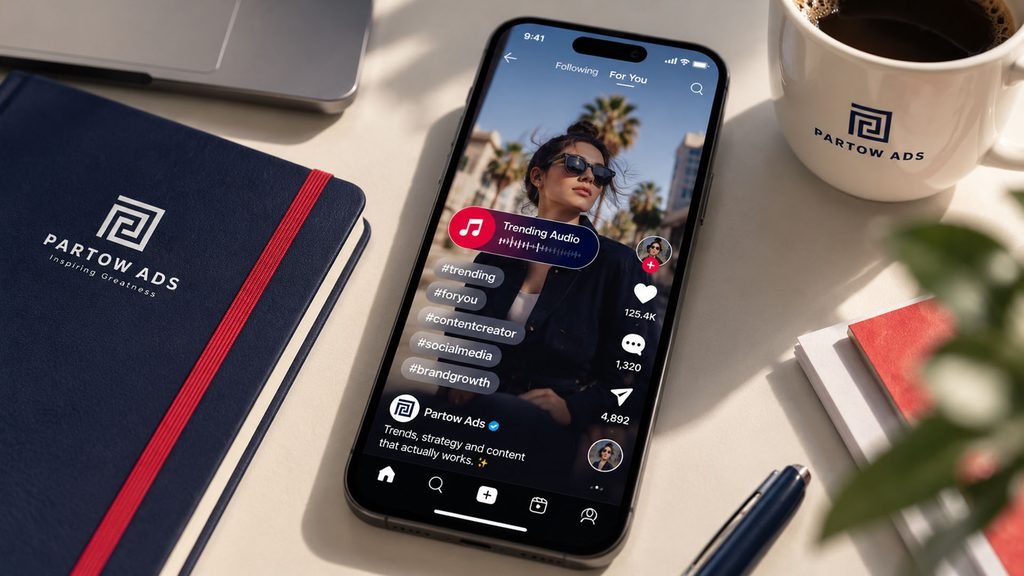
Sounds, memes, creator formats, challenges and cultural moments tend to spread fast, and TikTok’s own Creative Center actively tracks and surfaces them for advertisers.
Instagram often picks up the same trends, but the execution differs, Reels, carousels, Stories and creator collaborations all play a different role here than they do on TikTok.
YouTube
YouTube trends can live longer. A trend might become a Short, a long-form tutorial, a review, an explainer or a search-driven topic. YouTube’s own Culture & Trends team actively tracks how cultural moments move on and off the platform through creators and fans.
A TikTok-style trending sound may not be the right fit for most LinkedIn content. Industry conversations, expert opinions and timely business topics are often more relevant to the platform’s professional context.
Same internet. Very different audience behaviour on each app.
Where to Actually Find Social Media Trends
Stop scrolling your own feed for inspiration, that’s a personal algorithm, not market research. Use a structured process instead.
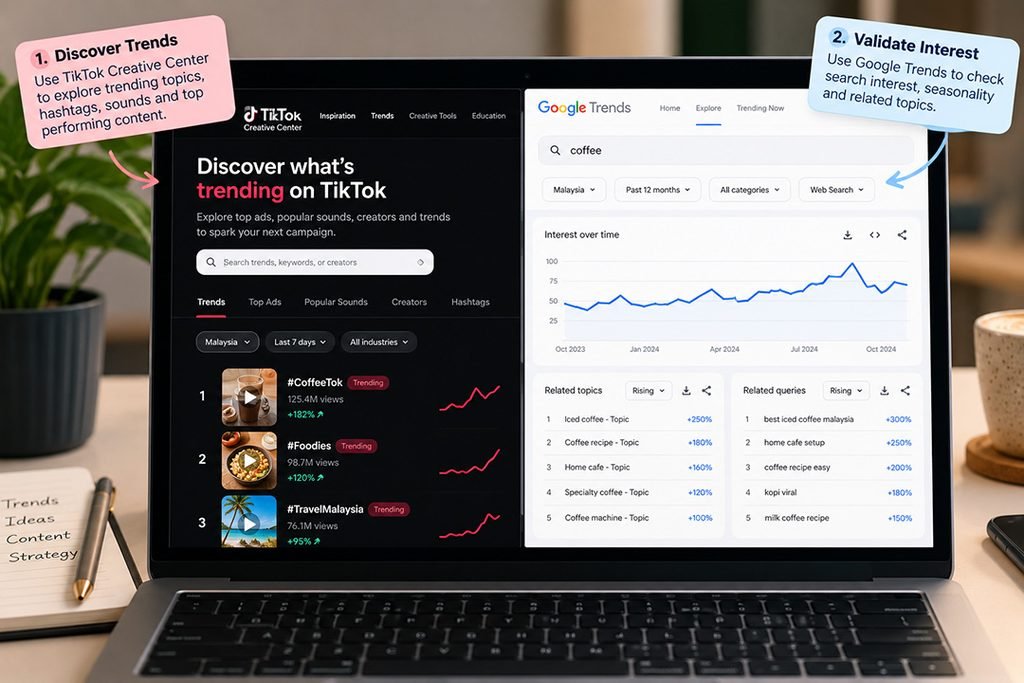
1. TikTok Creative Center
TikTok Creative Center is a free, public tool for discovering trending hashtags, songs, keywords and top-performing ad creative, filterable by industry and region.
Instead of asking “what’s viral?”, ask: “what’s gaining momentum that could genuinely fit my audience?”
2. Google Trends
Social platforms show you what people are engaging with. Google Trends shows you what people are actually searching for, which is often more valuable for blog content, SEO, and campaign ideas than a viral view count.
3. Study Your Competitors
Not to copy them, to spot what changed. Are they producing more video? Working with creators? Testing a new platform? The useful question is “what changed in their strategy?”, not “what did they post today?”
4. Watch Creators, Not Just Brands
Creators are usually closer to emerging formats than brands are. Our guide to TikTok Influencer Marketing in Malaysia breaks down how to evaluate creators by audience fit and content style, not just follower count, which is exactly the lens to use when scouting emerging trends too.
5. Listen to Your Own Audience
Comments, DMs, customer reviews, on-site search queries and sales-team feedback are an underused trend source. A trend your own audience already cares about is usually more valuable than a random viral topic with no connection to your business.
The 5-Second Trend Test
Before jumping on any trend, run it through five quick questions:
- Is it relevant? Does your audience actually care?
- Is it on-brand? Would people recognise this as you?
- Is it platform-native? Does it make sense on this specific app?
- Does it have a purpose? What are you trying to achieve?
- Can you make it yours? Can you add your own angle instead of copying everyone else?
Yes to most of them? You’ve probably found an opportunity. Mostly no? Scroll past it, that’s a strategic decision too.
How to Know If a Trend Is Still Trending
A trend can still look popular in your own feed even after its real momentum has already started to decline, the algorithm keeps showing you what you’ve already engaged with, which isn’t the same as what’s currently growing.
Before investing time and production budget into a trend, check whether it is actually growing, stable, or already fading. Look at recent usage volume, search interest over time, how many creators are still adopting it, and platform-specific trend data, not just what your personal feed happens to be showing you right now.
TikTok Creative Center and Google Trends both show trend trajectories over time, which is far more useful than a single snapshot of “what’s viral today.”
A Simple Trend Evaluation Framework
Every trend can be run through the same formula: Trend → Audience → Brand → Platform → Objective → Execution. If any link in that chain doesn’t make sense, pause before you produce anything.
| Question | What To Ask |
| Trend | Is this actually gaining momentum, or already fading? |
| Audience | Does our audience care about this? |
| Brand | Does it fit our identity and tone of voice? |
| Platform | Is this the right format for this specific channel? |
| Objective | What are we actually trying to achieve with it? |
| Execution | Can we make it authentic, on-brand and timely? |
How to Use a Trend Without Looking Like Everyone Else
The fastest way to lose your brand identity is to copy a trend exactly. Use the mechanic, not the copy:
- If a storytelling format is trending: use the structure to tell your own story
- If a sound is trending: pair it with your own visual concept
- If a meme is trending: adapt the idea to your industry’s reality
- If an editing style is trending: apply it to your existing brand language
Don’t copy the trend. Interpret it. The strongest trend-based content doesn’t look like everyone else’s version, it looks like your brand’s version.
Trend Content vs. Evergreen Content
| Trend Content | Evergreen Content |
| Fast-moving and culture-driven | Longer lifespan, educational or informational |
| Shorter lifespan | Search-friendly and builds authority over time |
| Higher reach potential, short-term | Generates traffic and leads long after publishing |
| Requires fast execution | Easier to repurpose across formats |
| Often platform-specific | Works across multiple channels |
There is no universal percentage split that works for every brand. The right balance between trend and evergreen content depends on your industry, audience, platform and objectives. The principle that matters: trends should be part of your content system, not the whole system.
What About Trending Music?
“This sound is trending, put it in the Reel” isn’t a strategy on its own. Before using trending audio, ask whether it’s still gaining momentum, whether it fits the concept and the brand, and – critically – whether your account can legally use it for commercial content.
A sound being popular doesn’t automatically mean it’s cleared for every commercial use. Trending audio can absolutely help content feel native to a platform. But audio is one ingredient, not the strategy itself.
When Should a Brand NOT Follow a Trend?
- It doesn’t fit your audience, millions of views from the wrong audience isn’t a result
- It conflicts with your brand values or positioning
- It feels forced, audiences can tell when a brand is trying too hard to “look cool”
- It’s already oversaturated by every other business account
- You genuinely can’t execute it authentically in your voice
- There’s no real business or communication purpose behind it
Virality is not the same thing as marketing effectiveness.
Trend Chasing vs. Trend Strategy, Side by Side
| Trend Chasing | Trend Strategy |
| Focuses on views | Connects to a business objective |
| Short-term thinking | Part of a repeatable content system |
| Ignores brand identity | Works inside the brand system |
| Same content everywhere | Adapted to each platform |
| Measures virality | Measures meaningful outcomes |
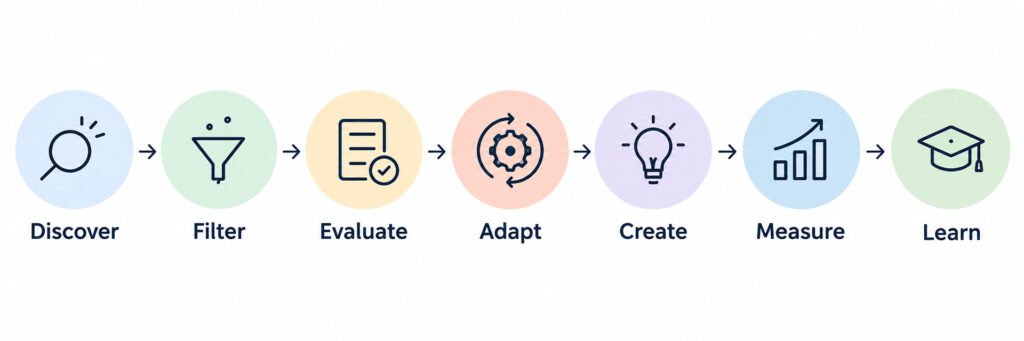
A Practical Trend-to-Content Workflow
A simple, repeatable process any content team can follow:
- Discover: find emerging trends across relevant platforms
- Filter: remove anything that doesn’t fit your audience or industry
- Evaluate: check brand fit, platform fit and business objective
- Adapt: build your own creative interpretation
- Produce: create it using your brand’s visual and verbal system
- Publish: optimise the format for the specific platform
- Measure: look beyond views at outcomes that matter
- Learn: feed the results into the next piece of content
So, Should Your Brand Follow Trends?
Yes, but selectively, and always through a filter. You don’t need to become a different brand every time TikTok changes. You don’t need every trending sound, every viral meme, or every format everyone else is using.
Stay consistent in who you are. Stay flexible in how you communicate. That’s the entire balance.
Need a Content Strategy That Knows When to Follow the Trend, and When to Ignore It?
At Partow Ads, we don’t believe every brand needs to jump on every viral trend. We help brands build content strategies that combine Brand Identity, Creative Content, Social Media Strategy and Digital Marketing, so your content stays relevant without losing what makes it recognisable.
Frequently Asked Questions
How do I find social media trends?
Use platform-specific tools such as TikTok Creative Center and Google Trends, alongside Instagram’s Explore tab, creator accounts, competitor research and your own audience analytics.
Should brands follow every TikTok trend?
No. Evaluate each trend against audience relevance, brand fit, platform suitability, timing and your actual business objective before using it.
Are TikTok trends the same as Instagram trends?
Not necessarily. A trend can cross platforms, but audience behaviour, execution and platform culture can differ significantly between TikTok, Instagram, YouTube and LinkedIn.
Should a brand follow trends or its brand identity?
Brand identity should always be the foundation. Trends can influence how content is executed without changing the brand’s core identity, tone or positioning.
How can brands use trending sounds safely?
Adapt relevant trending audio to your own content, but always check whether the audio is appropriately licensed for commercial use on that specific platform.
Is trending content better than evergreen content?
Neither is automatically better. Trend-based content helps a brand join current conversations, while evergreen content keeps generating value and search visibility over a longer period. A balanced strategy uses both.
Sources & Further Reading
TikTok Creative Center – official trend and creative discovery resource
Google Trends official search trend discovery platform
DataReportal Digital 2026 Global Overview Report – global social media adoption statistics
YouTube Culture & Trends official YouTube cultural trend tracking
Categorise
Tags
#advertising (11) #advertising-agency (6) #advertising-strategies (4) #brand-story (1) Branding (7) digital marketing (7) Marketing (8) partow ads (4) social media campaign (1) Strategies (2)
Recent Posts
- Meta One Malaysia: Pricing, Plus Plans & Business Features

- ChatGPT Ads in Malaysia: Cost, Availability & How It Works?

- Does AI-Generated Content Get Less Reach on Social Media in 2026?

- Trend or Trap? A Brand’s Guide to Choosing Social Media Trends Without Losing Its Identity
- Brand Identity & Brand System: Building a Strong, Consistent Brand


Leave a Reply